
Early Years Supervision
A protected space to think, reflect, and grow.
Reflective supervision for Early Years settings and the practitioners within them, because good supervision changes people, not just practice.

When supervision became a requirement in the Early Years Foundation Stage in 2012, most settings did what they could with what they had. A form. A date in the diary. A manager doing their best in a role nobody had really trained them for.
That wasn't a failure of leadership. It was a failure of support.
More than a decade on, many settings are still working from that same starting point — going through the motions of supervision without ever experiencing what it can actually do.
Done well, supervision is one of the most powerful tools a setting has. Not for compliance. For growth.
What supervision should actually feel like
Supervision at its best is a protected space where a practitioner can
slow down, think clearly,
and leave feeling more capable than when they walked in.
Not a tick-box. Not a performance review.
Not a quick catch-up squeezed between nappy changes and snack time.
A genuine conversation. Led by the practitioner.
Held by someone who knows how to ask the right questions and sit with the answers.
The quick fix problem
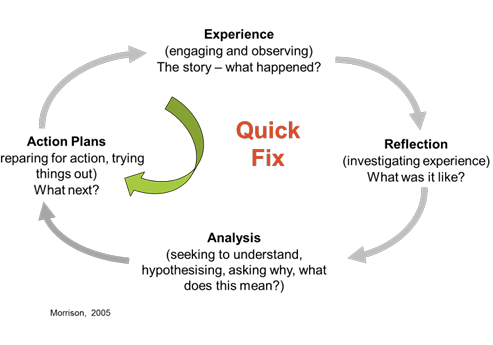
The diagram shows a reflective cycle — experience, reflection, analysis, action. It's the foundation of good supervision practice. (Morrison, 2005)
The temptation in supervision, especially when time is short and everyone is stretched, is to skip straight to the action plan. To jump from "what happened?" to "what are you going to do about it?" without ever really stopping to understand why.
That's the quick fix. And it's exactly what good supervision avoids.
Real supervision moves through the whole cycle. It makes space for reflection and analysis, the messy, slower, more uncomfortable parts because that's where the real thinking happens. That's where practice actually changes.
Why external supervision makes a difference
If you're a manager in an Early Years setting, chances are you're already doing some version of supervision. You care about your team. You check in. You notice when someone's struggling and you make time for them.
That matters. And it's not nothing.
But there's something an internal supervisor, however skilled and caring, can't fully offer. And that's distance.
When you're part of the same team, the same building, the same daily pressures, it's almost impossible to hold truly neutral space. You know the context. You have your own perspective on the situation. You're also, in many cases, the person the practitioner is worried about disappointing.
An external supervisor changes that dynamic entirely.
Your practitioners can think out loud without worrying about what it means for their next supervision form, their appraisal, or their relationship with you. They can be honest in ways that are harder when the person listening is also their manager.
And for you… bringing in external supervision for your team isn't a sign that you're not doing enough. It's a sign that you understand what good supervision actually requires. It frees you to be the leader your team needs, without also having to be the neutral thinking partner they deserve.
How I can support you
Whole-setting supervision
A structured reflective model for your whole team, built around regular sessions that develop thinking, confidence and practice — not just compliance.
Individual supervision
A protected 1:1 space for practitioners who want to think more clearly about their work, their leadership, or where they're heading next.
Leadership supervision
For nursery managers, deputies and SENDCos carrying the particular weight of being the person everyone looks to.
Space to think that's just for you.
Support for leaders delivering supervision
If you're the person responsible for supervising your team but nobody ever really showed you how, this is for you. Practical, reflective support to help you supervise with more confidence, more structure, and more impact.
Curious whether this is right for your setting?
If you're not sure where to start, start with a conversation. We'll talk about your setting, what supervision looks like for you right now, and what it could look like instead.
How it works
-
Most settings work on a monthly or half-termly rhythm — whatever is realistic and sustainable for your team. We'll talk about what works for your setting before anything is agreed.
-
Individual and leadership supervision sessions are typically an hour. Whole-setting sessions may be longer depending on team size and format. We'll agree this together at the start.
-
Online, via video call — so accessible wherever your setting is based. If you're local to Worcestershire, Herefordshire, or Shropshire, in-person sessions may also be possible.
-
That's completely fine — and more common than you'd think. Start with a free introductory conversation and we'll work it out together. You don't need to arrive with a clear plan.
-
Individual and leadership supervision sessions are £55 per session.
Whole-setting supervision is priced depending on team size, frequency, and the level of support involved. Get in touch and we'll work out something that's fair for your setting.
-
They overlap, but they're not the same thing. Supervision is rooted in practice — it's about the work, the children, the team, and the challenges that come with the role. Coaching tends to focus more on the individual — their goals, their development, their direction. Some people benefit from both. If you're not sure which one you need, we can talk that through too.